How to Measure Your Bra Size at Home
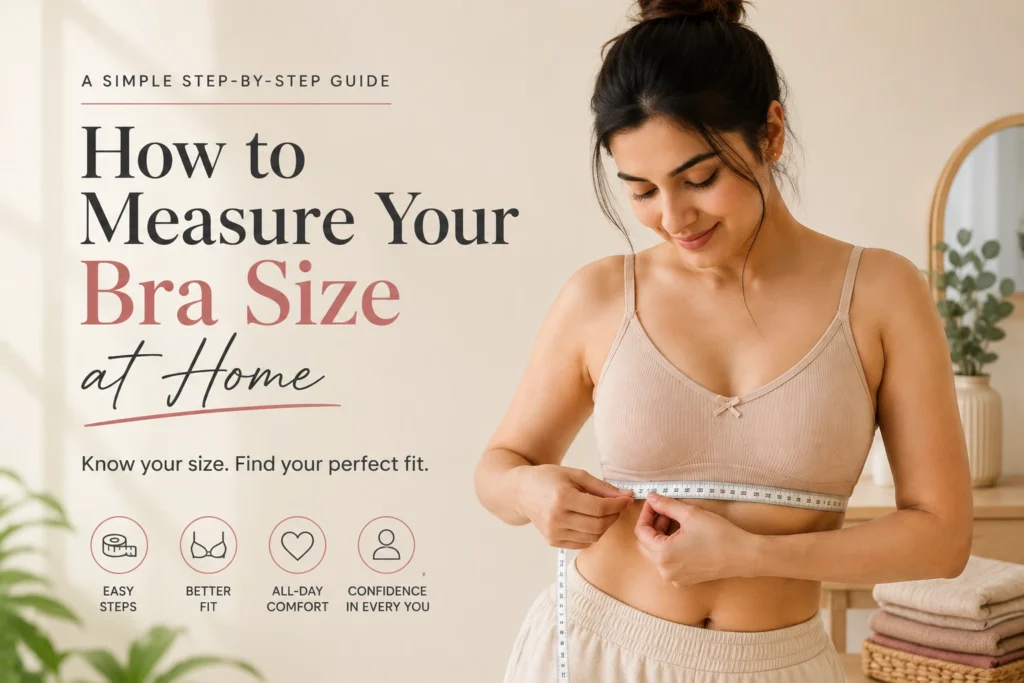
You can measure your bra size at home with just a soft measuring tape and a mirror. Measure your underbust to estimate your band size, then measure around the fullest part of your bust. Use these measurements together with the sizing method of the brand you’re buying from to find your starting bra size. The important word here is starting. Bra sizing isn’t perfectly standardized across every brand or style, so your measurements should guide you towards the right size rather than be treated as an absolute rule. Why Knowing Your Bra Size Matters A bra can be beautifully made and still feel uncomfortable if the size isn’t right. A band that’s too loose may ride up your back. Cups that are too small can cause spillage, while cups that are too large may gape. Straps may also slip or dig into your shoulders when the overall fit isn’t right. The good news is that you don’t necessarily need a professional fitting to get a useful starting point. You can take your measurements at home in a few minutes. What You’ll Need A soft measuring tape A mirror A non-padded, lightly structured bra or no bra A pen and paper or your phone to record the measurements Avoid measuring over thick clothing or a heavily padded bra because it can change the bust measurement. Stand naturally rather than deliberately expanding your chest or holding your stomach in. Step 1: Measure Your Underbust Your underbust is the circumference of your ribcage directly underneath your breasts. Stand in front of a mirror and wrap the measuring tape around your ribcage, immediately below your bust where your bra band would normally sit. Make sure the tape is: Level around your body Snug, but not painfully tight Flat against your skin Not twisted at the back Take the measurement in inches and write it down. Example: Underbust measurement: 30 inches How Does This Become Your Band Size? This is where bra sizing can become confusing. Foma Innerwear uses a legacy manufacturing sizing method in which the band size includes a comfort allowance. For example, an underbust measurement of 30 inches corresponds to a 34 band using this method. Other brands may use different sizing systems, which is why the same body measurements can sometimes produce different recommended sizes. If you’re shopping for Foma bras, use our Bra Size Guide & Size Calculator to convert your measurements into the size used for our bras. Step 2: Measure Your Bust Next, measure your overbust or bust circumference. Wrap the measuring tape around the fullest part of your breasts. Check yourself in the mirror and make sure the tape runs horizontally around your body. The tape should rest gently against your body. Don’t pull it so tightly that it compresses your breasts, but don’t leave it hanging loose either. Write down this measurement. Example: Bust measurement: 37 inches Now you have the two measurements needed to estimate your bra size: Measurement Example Underbust 30 inches Full Bust 37 inches Step 3: Find Your Band Size Use your underbust measurement with the size chart provided by the bra brand you’re considering. This step matters because bra sizing isn’t completely uniform between brands. A measurement that points towards one size on one company’s chart may point towards a slightly different size elsewhere. Foma Fit Tip Think of your measurements as your starting point. When shopping with Foma, enter your underbust and overbust measurements into our size calculator to see the recommended Foma size. Check Your Foma Bra Size → Step 4: Find Your Cup Size Cup size is determined by the relationship between your bust and band measurements rather than by your bust measurement alone. Under Foma’s sizing method, cup size is calculated using the difference between your overbust measurement and calculated band size. Difference Approximate Cup 1 inch A 2 inches B 3 inches C 4 inches D For example, using Foma’s sizing method: Underbust: 30″ Calculated band: 34 Overbust: 37″ Difference: 3″ Recommended size: 34C You can skip doing this calculation manually by using the Foma Bra Size Calculator . Your Bra Size Is More Than a Number Suppose two women both wear a B cup. That doesn’t mean their cups are the same size. A 32B and 38B are not equivalent bras because cup volume changes along with band size. That’s one reason saying “I’m a B cup” doesn’t provide your complete bra size. Your complete bra size includes both: Band Size + Cup Size For example: 34B Step 5: Try the Bra and Check the Actual Fit Measurements narrow down your options. The bra itself tells you whether you’ve found the right fit. 1. Check the Band The band should sit relatively level around your body rather than climbing significantly up your back. It should feel secure without making it difficult to breathe comfortably. A new bra is generally best assessed on its loosest comfortable hook so you have room to adjust the band as the elastic changes with wear. 2. Check the Cups Your breasts should sit comfortably inside the cups. Cup may be too small if: Breast tissue spills over the top or sides The cup edge noticeably cuts into the breast You feel compressed inside the cup Cup may be too large if: There’s empty space inside the cup The fabric wrinkles or gapes The cup doesn’t sit against the breast properly 3. Check the Straps The straps shouldn’t constantly fall off your shoulders, but they also shouldn’t need to be tightened so much that they dig deeply into your skin. The band provides an important part of a bra’s support, so overtightening the straps shouldn’t be the solution to a loose band. 4. Move Around Don’t judge the fit while standing perfectly still. Try: Raising your arms Sitting down Bending slightly Moving your shoulders Walking around The bra should stay reasonably secure and comfortable as you move. Common Mistakes When Measuring Bra Size at Home Pulling the Measuring Tape Too